Next: 3D rigid bodies Up: 4.3 Configuration Space Obstacles Previous: A polyhedral C-space obstacle
 : The General Case
Unfortunately, the cases in which
is polygonal or polyhedral
are quite limited. Most problems yield extremely complicated C-space
obstacles. One good point is that
can be expressed using
semi-algebraic models, for any robots and obstacles defined using
semi-algebraic models, even after applying any of the transformations
from Sections 3.2 to 3.4. It might not be
true, however, for other kinds of transformations, such as warping a
flexible material [32,577].
Consider the case of a convex polygonal robot and a convex polygonal
obstacle in a 2D world. Assume that any transformation in  may
be applied to
may
be applied to  ; thus,
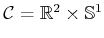 and
and
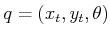 . The task is to define a set of algebraic
primitives that can be combined to define
. Once again, it is important to distinguish between Type
EV and Type VE contacts.
Consider how to construct the algebraic primitives for the Type EV contacts; Type VE can be handled in a
similar manner.
. The task is to define a set of algebraic
primitives that can be combined to define
. Once again, it is important to distinguish between Type
EV and Type VE contacts.
Consider how to construct the algebraic primitives for the Type EV contacts; Type VE can be handled in a
similar manner.
For the translation-only case, we were able to determine all of the
Type EV contacts by sorting the edge normals.
With rotation, the ordering of edge normals depends on  . This
implies that the applicability of a Type EV
contact depends on , the robot orientation. Recall the
constraint that the inward normal of must point between the
outward normals of the edges of
. This
implies that the applicability of a Type EV
contact depends on , the robot orientation. Recall the
constraint that the inward normal of must point between the
outward normals of the edges of  that contain the vertex of
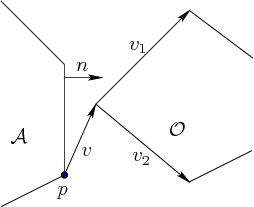
contact, as shown in Figure 4.21. This constraint can be
expressed in terms of inner products using the vectors
that contain the vertex of
contact, as shown in Figure 4.21. This constraint can be
expressed in terms of inner products using the vectors  and
and
 . The statement regarding the directions of the normals can
equivalently be formulated as the statement that the angle between
. The statement regarding the directions of the normals can
equivalently be formulated as the statement that the angle between  and , and between and , must each be less than
  .
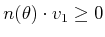
Using inner products, this implies that
.
Using inner products, this implies that
 and
and
 . As in the translation case, the condition
 is required for contact. Observe that now depends on
. For any
is required for contact. Observe that now depends on
. For any
 , if
, if
 ,
,
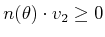 , and
, and
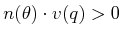 , then
 . Let
. Let  denote the set of configurations that satisfy
these conditions. These conditions imply that a point is in
denote the set of configurations that satisfy
these conditions. These conditions imply that a point is in
 .
Furthermore, any other Type EV and Type
VE contacts could imply that more points are in
. Ordinarily,
.
Furthermore, any other Type EV and Type
VE contacts could imply that more points are in
. Ordinarily,
 , which implies that the
complement,
, which implies that the
complement,
 , is a superset of
(thus,
, is a superset of
(thus,
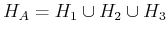
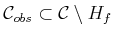 ). Let
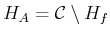 . Using the
primitives
. Using the
primitives
 |
(4.39) |
 |
(4.40) |
 |
(4.41) |
 .
.
It is known that
 , but
, but  may contain points
in
. The situation is similar to what was explained in
Section 3.1.1 for building a model of a convex polygon
from half-planes. In the current setting, it is only known that any
configuration outside of must be in
. If is
intersected with all other corresponding sets for each possible Type
EV and Type VE contact,
then the result is
. Each contact has the opportunity to
remove a portion of
from consideration. Eventually, enough
pieces of
are removed so that the only configurations
remaining must lie in
. For any Type EV contact,
may contain points
in
. The situation is similar to what was explained in
Section 3.1.1 for building a model of a convex polygon
from half-planes. In the current setting, it is only known that any
configuration outside of must be in
. If is
intersected with all other corresponding sets for each possible Type
EV and Type VE contact,
then the result is
. Each contact has the opportunity to
remove a portion of
from consideration. Eventually, enough
pieces of
are removed so that the only configurations
remaining must lie in
. For any Type EV contact,
 . A similar statement can be
made for Type VE contacts. A logical
predicate, similar to that defined in Section 3.1.1, can
be constructed to determine whether
. A similar statement can be
made for Type VE contacts. A logical
predicate, similar to that defined in Section 3.1.1, can
be constructed to determine whether
 in time that is
linear in the number of
primitives.
in time that is
linear in the number of
primitives.
One important issue remains. The expression  is not a
polynomial because of the
is not a
polynomial because of the
 and
and
 terms in the
rotation matrix of
terms in the
rotation matrix of  . If polynomials could be substituted for
these expressions, then everything would be fixed because the
expression of the normal vector (not a unit normal) and the inner
product are both linear functions, thereby transforming polynomials
into polynomials. Such a substitution can be made using stereographic
projection (see [588]); however, a simpler approach is to use
complex numbers to represent rotation. Recall that when
. If polynomials could be substituted for
these expressions, then everything would be fixed because the
expression of the normal vector (not a unit normal) and the inner
product are both linear functions, thereby transforming polynomials
into polynomials. Such a substitution can be made using stereographic
projection (see [588]); however, a simpler approach is to use
complex numbers to represent rotation. Recall that when  is
used to represent rotation, each rotation matrix in is
represented as (4.18), and the
is
used to represent rotation, each rotation matrix in is
represented as (4.18), and the
 homogeneous transformation matrix becomes
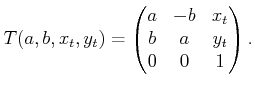 |
(4.42) |
![$ [x \; y \; 1]$](img1452.gif) results in the
point coordinates
results in the
point coordinates
 . Thus, any
transformed point on is a linear function of
. Thus, any
transformed point on is a linear function of  ,
,  ,
,  , and
, and
 .
.
This was a simple trick to make a nice, linear function, but what was
the cost? The dependency is now on and instead of .
This appears to increase the dimension of  from 3 to 4, and
 . However, an algebraic primitive
must be added that constrains and to lie on the unit circle.
. However, an algebraic primitive
must be added that constrains and to lie on the unit circle.
By using complex numbers, primitives in
 are obtained for each
Type EV and Type VE
contact. By defining
, the following algebraic
primitives are obtained for a Type EV
contact:
are obtained for each
Type EV and Type VE
contact. By defining
, the following algebraic
primitives are obtained for a Type EV
contact:
 |
(4.43) |
 |
(4.44) |
 |
(4.45) |
. To preserve the correct
 topology of , the set
 |
(4.46) |
. The set  remains fixed over all Type
EV and Type VE contacts;
therefore, it only needs to be considered once.
remains fixed over all Type
EV and Type VE contacts;
therefore, it only needs to be considered once.
)
Consider adding rotation to the model described in Example
4.15. In this case, all possible contacts between pairs of
edges must be considered. For this example, there are  Type
EV contacts and Type VE contacts. Each contact produces
Type
EV contacts and Type VE contacts. Each contact produces  algebraic
primitives. With the inclusion of ,
this simple example produces
algebraic
primitives. With the inclusion of ,
this simple example produces  primitives! Rather than construct
all of these, we derive the primitives for a single contact. Consider
the Type VE contact between
primitives! Rather than construct
all of these, we derive the primitives for a single contact. Consider
the Type VE contact between  and
and
 -
- . The outward edge normal remains fixed at
 ![$ n =
[1,0]$](img1464.gif) . The vectors and are derived from the edges
adjacent to , which are -
. The vectors and are derived from the edges
adjacent to , which are - and -
and - . Note that
each of , , and depend on the configuration. Using
the 2D homogeneous transformation (3.35), at configuration
. Note that
each of , , and depend on the configuration. Using
the 2D homogeneous transformation (3.35), at configuration
 is
is
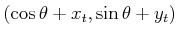 . Using
to represent rotation, the expression of becomes
. Using
to represent rotation, the expression of becomes
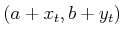 . The expressions of and are
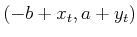 and
and
 , respectively. It follows
that
, respectively. It follows
that
![$ v_1 = a_2 - a_3 = [a - 2b, 2a + b]$](img1471.gif) and
and
![$ v_2 = a_1 - a_3 = [2a -
b, a + 2b]$](img1472.gif) . Note that and depend only on the orientation
of , as expected. Assume that
. Note that and depend only on the orientation
of , as expected. Assume that  is drawn from to .
This yields
is drawn from to .
This yields
![$ v = a_3 - b_4 = [-a + b + x_t- 1, -a - b + y_t+ 1]$](img1473.gif) .
The inner products
.
The inner products
 ,
,
 , and
, and  can
easily be computed to form
can
easily be computed to form  ,
,  , and
, and  as algebraic
primitives.
as algebraic
primitives.
One interesting observation can be made here. The only nonlinear
primitive is
 . Therefore,
can be considered as
a linear polytope (like a polyhedron, but one dimension higher) in
that is intersected with a cylinder.
. Therefore,
can be considered as
a linear polytope (like a polyhedron, but one dimension higher) in
that is intersected with a cylinder.