


Next: Planning on the cube Up: 7.2.2 Decoupled planning Previous: Fixed-roadmap coordination
How is the coordination space represented when there are multiple
paths for each robot? It turns out that a cube complex is
obtained, which is a special kind of singular complex (recall from
Section 6.3.1). The coordination space for  fixed
paths can be considered as a singular -simplex. For example, the
problem in Figure 7.9 can be considered as a singular
fixed
paths can be considered as a singular -simplex. For example, the
problem in Figure 7.9 can be considered as a singular
 -simplex,
![$ [0,1]^3 \rightarrow X$](img2671.gif) . In Section 6.3.1,
the domain of a
. In Section 6.3.1,
the domain of a  -simplex was defined using
  , a -dimensional
ball; however, a cube,
, a -dimensional
ball; however, a cube, ![$ [0,1]^k$](img2673.gif) , also works because and
are homeomorphic.
, also works because and
are homeomorphic.
For a topological space,  , let a -cube (which is also a
singular -simplex),
, let a -cube (which is also a
singular -simplex),
 , be a continuous mapping
![$ {\sigma}:
[0,1]^k \rightarrow X$](img2675.gif) . A cube complex is obtained by connecting
together -cubes of different dimensions. Every -cube for
. A cube complex is obtained by connecting
together -cubes of different dimensions. Every -cube for  has
has  faces, which are
  -cubes that are
obtained as follows. Let
-cubes that are
obtained as follows. Let
 denote a point in
. For each
denote a point in
. For each
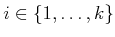 , one face is obtained by
setting
, one face is obtained by
setting  and another is obtained by setting
  .
.
The cubes must fit together nicely, much in the same way that the
simplexes of a simplicial complex were required to fit together. To
be a cube complex,  must be a collection of simplexes
that satisfy the following requirements:
must be a collection of simplexes
that satisfy the following requirements:
 , of a cube
 is also
in .
-cubes
is also
in .
-cubes
 , is either empty or there
exists some cube,
, is either empty or there
exists some cube,
 for
for  , which is a common
face of both
and
, which is a common
face of both
and
 .
.
Let
 denote a topological graph (which may also be a
roadmap) for robot
denote a topological graph (which may also be a
roadmap) for robot
 . The graph edges are paths of the form
![$ \tau : [0,1] \rightarrow {\cal C}^i_{free}$](img2688.gif) . Before covering formal
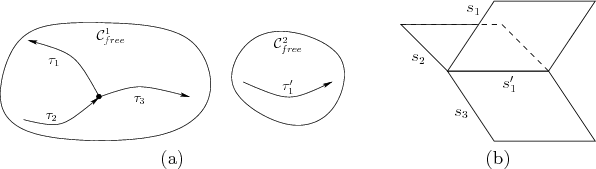
definitions of the resulting complex, consider Figure
7.10a, in which
. Before covering formal
definitions of the resulting complex, consider Figure
7.10a, in which
 moves along three paths
connected in a ``T'' junction and
moves along three paths
connected in a ``T'' junction and
 moves along one path. In
this case, three 2D fixed-path coordination spaces are attached
together along one common edge, as shown in Figure
7.10b. The resulting cube complex is defined by three
moves along one path. In
this case, three 2D fixed-path coordination spaces are attached
together along one common edge, as shown in Figure
7.10b. The resulting cube complex is defined by three
 -cubes (i.e., squares), one
  -cube (i.e., line segment), and
eight 0-cubes (i.e., corner points).
-cube (i.e., line segment), and
eight 0-cubes (i.e., corner points).
 |
Now suppose more generally that there are two robots,
and
, with associated topological graphs,
 and
and
 , respectively. Suppose that
  and
and
 have
have  and
and  edges, respectively. A 2D cube
complex, , is obtained as follows. Let
edges, respectively. A 2D cube
complex, , is obtained as follows. Let  denote the
 th path of
 , and let
  denote the
  th path
of
. A -cube (square) exists in for every way to
select an edge from each graph. Thus, there are
th path
of
. A -cube (square) exists in for every way to
select an edge from each graph. Thus, there are  -cubes,
one for each pair
-cubes,
one for each pair
 , such that
 and
and
 . The -cubes are generated for pairs of the form
 for
for
 and
, or
and
, or
 for
and
for
and
 . The 0-cubes
(corner points) are reached for each pair
. The 0-cubes
(corner points) are reached for each pair  such that
and
.
such that
and
.
If there are robots, then an -dimensional cube complex arises.
Every -cube corresponds to a unique combination of paths, one for
each robot. The  -cubes are the faces of the -cubes. This
continues iteratively until the 0-cubes are reached.
-cubes are the faces of the -cubes. This
continues iteratively until the 0-cubes are reached.
Steven M LaValle 2012-04-20