


Next: Conditional probability Up: 9.1.2 Probability Theory Review Previous: 9.1.2 Probability Theory Review
A probability space is a three-tuple,
 , in which
the three components are
, in which
the three components are
 called the sample
space, which represents
all possible outcomes.
called the sample
space, which represents
all possible outcomes.
 of subsets of ,
called the event space. If is discrete, then usually
of subsets of ,
called the event space. If is discrete, then usually
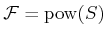 . If is continuous, then is usually a sigma-algebra
on , as defined in Section 5.1.3.
. If is continuous, then is usually a sigma-algebra
on , as defined in Section 5.1.3.
 , that assigns probabilities to
the events in . This will sometimes be referred to as a probability distribution over .
, that assigns probabilities to
the events in . This will sometimes be referred to as a probability distribution over .
 , must satisfy several basic axioms:
 for all
 .
.
 .
.
 if
if
 , for all
 .
is discrete, then the definition of over all of can
be inferred from its definition on single elements of by using the
axioms. It is common in this case to write
.
is discrete, then the definition of over all of can
be inferred from its definition on single elements of by using the
axioms. It is common in this case to write  for some
  ,
which is slightly abusive because
,
which is slightly abusive because  is not an event. It technically
should be
is not an event. It technically
should be  for some
 .
.
 to
to  painted on its sides. When the die comes to rest, it will always show
one number. In this case,
painted on its sides. When the die comes to rest, it will always show
one number. In this case,
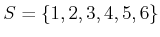 is the sample space.
The event space is
is the sample space.
The event space is
 , which is all
  subsets of .
Suppose that the probability function is assigned to indicate that all
numbers are equally likely. For any individual ,
subsets of .
Suppose that the probability function is assigned to indicate that all
numbers are equally likely. For any individual ,
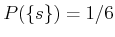 . The events include all subsets so that any probability
statement can be formulated. For example, what is the probability
that an even number is obtained? The event
. The events include all subsets so that any probability
statement can be formulated. For example, what is the probability
that an even number is obtained? The event
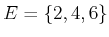 has
probability
has
probability
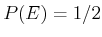 of occurring.

The third probability axiom looks similar to the last axiom in the
definition of a measure space in Section 5.1.3. In fact,
is technically a special kind of measure space as mentioned in
Example 5.12. If is continuous, however, this
measure cannot be captured by defining probabilities over the
singleton sets. The probabilities of singleton sets are usually zero.
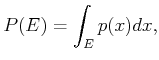
Instead, a probability density function,
 ,
is used to define the probability measure. The probability function,
, for any event
can then be determined via
integration:
,
is used to define the probability measure. The probability function,
, for any event
can then be determined via
integration:
 |
(9.3) |
 is the variable of integration. Intuitively,
indicates the total probability mass that accumulates over
is the variable of integration. Intuitively,
indicates the total probability mass that accumulates over  .
.