


Next: Plan extraction Up: 2.5.2 Building a Planning Previous: Layer-by-layer construction
During the construction of the planning graph, information about the
conflict between operators and literals within a layer is maintained.
A conflict is called a mutex condition, which means that a pair
of literals2.4 or pair of operators is
mutually exclusive. Both cannot be chosen simultaneously without
leading to some kind of conflict. A pair in conflict is called mutex. For each layer, a mutex relation is defined that
indicates which pairs satisfy the mutex condition. A pair,
 , of operators is defined to be mutex if any of these
conditions is met:
, of operators is defined to be mutex if any of these
conditions is met:
 is the negated
literal of an effect of
is the negated
literal of an effect of  .
is the negated literal
of a precondition of .
and , are mutex in
.
is the negated literal
of a precondition of .
and , are mutex in  .
.
 , of literals is
defined to be mutex if at least one of the two conditions is
met:
, of literals is
defined to be mutex if at least one of the two conditions is
met:
 and
and  form a complementary pair.
 , that achieve and is mutex. In this case, one
operator must achieve , and the other must achieve . If there
exists an operator that achieves both, then this condition is false,
regardless of the other pairs of operators.
, that achieve and is mutex. In this case, one
operator must achieve , and the other must achieve . If there
exists an operator that achieves both, then this condition is false,
regardless of the other pairs of operators.
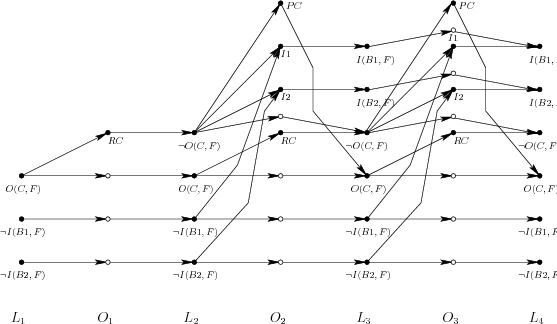 |
 expresses the initial
state. The only applicable operator is
expresses the initial
state. The only applicable operator is 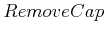 . The operator
layer
. The operator
layer  contains and three trivial operators, which
are needed to maintain the literals from . The appearance of
contains and three trivial operators, which
are needed to maintain the literals from . The appearance of
 enables the battery-insertion operator to
apply. Since variables are not allowed in operator definitions in a
planning graph, two different operators (labeled as
enables the battery-insertion operator to
apply. Since variables are not allowed in operator definitions in a
planning graph, two different operators (labeled as  and
and  )
appear, one for each battery. Notice the edges drawn to and
from their preconditions. The cap may also be replaced; hence,
)
appear, one for each battery. Notice the edges drawn to and
from their preconditions. The cap may also be replaced; hence,
 is included in
  . At the
  layer, all possible
literals have been obtained. At
layer, all possible
literals have been obtained. At  , all possible operators,
including the trivial ones, are included. Finally,
, all possible operators,
including the trivial ones, are included. Finally,  , and
, and
 will be the same as . This implies that the planning graph
has stabilized.
will be the same as . This implies that the planning graph
has stabilized.

Steven M LaValle 2012-04-20