


Next: Value iteration Up: 10.4 Reinforcement Learning Previous: Temporal differences
This section moves from evaluating a plan to computing an optimal plan
in the simulation-based framework. The most important idea is the
computation of Q-factors,  . This is
an extension of the optimal cost-to-go,
. This is
an extension of the optimal cost-to-go,  , that records optimal
costs for each possible combination of a state,
, that records optimal
costs for each possible combination of a state,  , and action
 . The interpretation of is the expected cost
received by starting from state
. The interpretation of is the expected cost
received by starting from state  , applying
  , and then following
the optimal plan from the resulting next state,
, and then following
the optimal plan from the resulting next state,
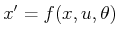 .
If happens to be the same action as would be selected by the
optimal plan,
.
If happens to be the same action as would be selected by the
optimal plan,  , then
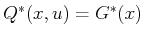 . Thus, the
Q-value can be thought of as the cost of making an arbitrary choice in
the first stage and then exhibiting optimal decision making
afterward.
. Thus, the
Q-value can be thought of as the cost of making an arbitrary choice in
the first stage and then exhibiting optimal decision making
afterward.