


Next: 9.1.3 Randomized Strategies Up: 9.1.2 Probability Theory Review Previous: Random variables
The expectation or expected value of a random variable  is denoted by
 ![$ E[X]$](img3450.gif) . It can be considered as a kind of weighted
average for , in which the weights are obtained from the
probability distribution. If
. It can be considered as a kind of weighted
average for , in which the weights are obtained from the
probability distribution. If  is discrete, then
![$\displaystyle E[X] = \sum_{s \in S} X(s) P(s) .$](img3451.gif) |
(9.10) |
is continuous, then9.2
is discrete and an event  is given, then
are
already real numbers. Hence, a random variable can be defined by
simply letting  . Using (9.11), the expected
value, , is
. Using (9.11), the expected
value, , is  . Note that the expected value is not
necessarily a value that is ``expected'' in practice. It is
impossible to actually obtain , even though it is not contained
in . Suppose that the expected value of is desired only over
trials that result in numbers greater then
. Note that the expected value is not
necessarily a value that is ``expected'' in practice. It is
impossible to actually obtain , even though it is not contained
in . Suppose that the expected value of is desired only over
trials that result in numbers greater then  . This can be described
by the event
. This can be described
by the event
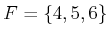 . Using conditional expectation,
(9.12), the expected value is
. Using conditional expectation,
(9.12), the expected value is
![$ E[X\vert F] = 5$](img3457.gif) .
.
Now consider tossing two dice in succession. Each element  is expressed as
  in which
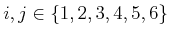 . Since
 , the random variable needs to be slightly more
interesting. One common approach is to count the sum of the dice,
which yields
, the random variable needs to be slightly more
interesting. One common approach is to count the sum of the dice,
which yields
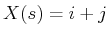 for any . In this case,
 ![$ E[X] =
7$](img3462.gif) .
.

Steven M LaValle 2012-04-20
![$\displaystyle E[X] = \int_{S} X(s) p(s) ds.$](img3452.gif)
![$\displaystyle E[X\vert F] = \sum_{s \in S} X(s) P(s\vert F) .$](img3453.gif)